A well-funded skincare brand recently came to a formulation consultancy with a familiar problem. Their anti-ageing serum tested beautifully in the lab. Peptides, antioxidants and a premium retinol alternative all performed as expected on paper. Yet consumer trials told a different story: uneven results, reports of sensitivity, and lacklustre repeat purchase rates. The active ingredients weren't the issue. The gap was in how the formulation addressed skin as a living, responsive system rather than a static surface to be treated.
This is a pattern many cosmetic brands and formulators encounter, and it points to a shift that is reshaping the well-ageing category.
Skin Ageing Is No Longer Just a Structural Story
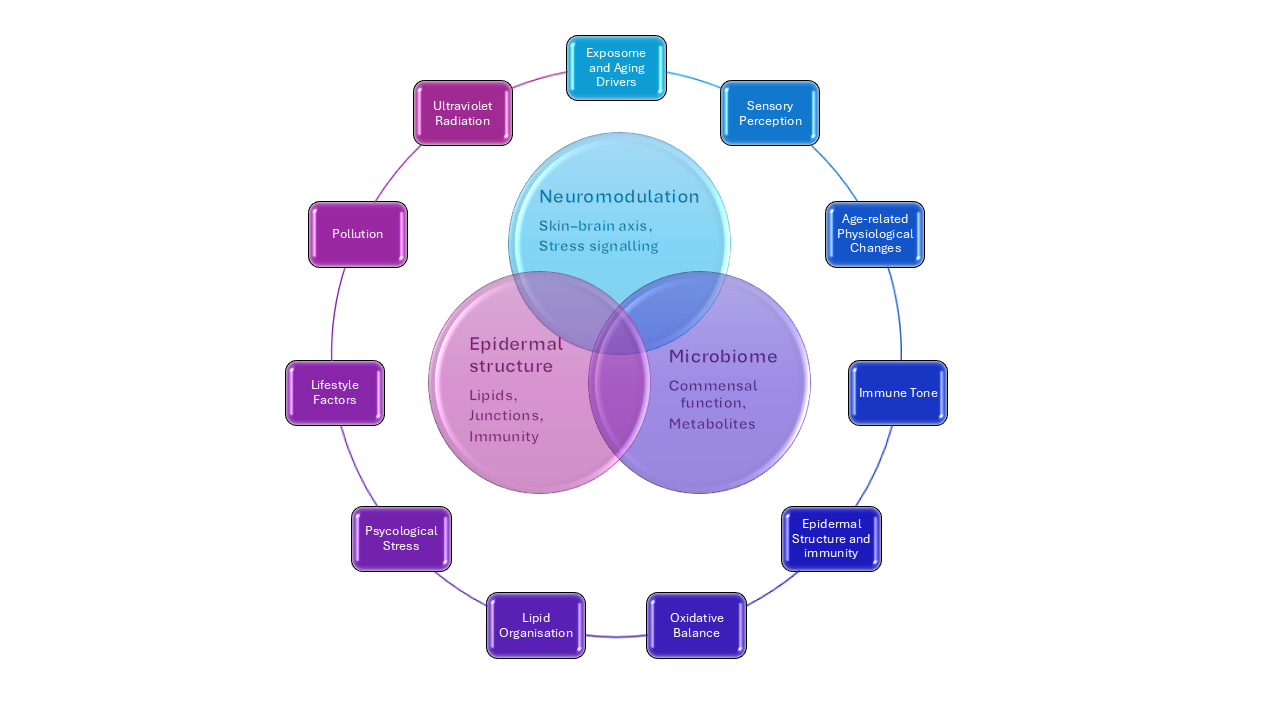
For decades, cosmetic science focused on collagen loss, elastin breakdown and declining dermal density. These processes matter, but they don't explain why two people of the same age, with similar genetics, can show markedly different signs of ageing. Increasingly, the research points to two upstream regulators that brands cannot afford to ignore: neuromodulation and microbiome stability.
Put simply, the skin behaves like a neuroimmune-microbial interface. It receives and responds to signals from the nervous system, the endocrine system and its resident microbial community, all at once. When these systems fall out of alignment, the visible signs of ageing accelerate, even when the skin's underlying structural proteins are otherwise healthy.
The Stress Pathway Brands Often Overlook
Psychological and environmental stress activate the sympathetic nervous system and the hypothalamic-pituitary-adrenal axis, triggering cortisol release both systemically and locally within the skin. This has measurable consequences for product performance: reduced lipid synthesis, suppressed production of key barrier proteins such as filaggrin and loricrin, and slower recovery after cleansing or environmental exposure.
Sensory stress signalling plays a role too. When sensory nerves are stimulated, they release neuropeptides that promote inflammation and compromise the skin's tight junctions. For brands, this means that a product's sensorial experience is not a marketing afterthought. Texture, fragrance and tactile feel directly influence the biological stress response the skin undergoes during application.
What this means in practice: formulations that reduce sensory friction, support a calming application experience, or incorporate ingredients shown to modulate stress signalling can measurably improve barrier recovery, independent of any active ingredient added for that purpose.
Microbiome Function Matters More Than Microbiome Diversity
A second, equally important insight challenges a common assumption in the industry: that a more diverse microbiome is automatically a healthier one. The evidence tells a more nuanced story. As skin ages, sebum and sweat production decline, surface pH rises, and immune surveillance weakens. This creates a shift not necessarily towards fewer microbial species, but towards a loss of functional capacity, meaning fewer of the beneficial metabolic processes that actually protect skin.
Beneficial commensal bacteria support ceramide synthesis, generate antioxidant compounds, and stimulate the skin's own antimicrobial peptides. When these functions decline, barrier resilience drops even if microbial diversity looks stable on a swab test.
For product developers, this reframes the goal. Rather than designing formulations that aim to increase microbial diversity or eliminate specific species, the more productive strategy is supporting the metabolic activity of beneficial commensals already present on skin.
Four Markers That Tie It All Together
Across this research, four epidermal markers consistently emerge as shared endpoints where neuromodulation and microbiome health converge:
- Lipid organisation within the stratum corneum
- Tight junction integrity in the upper epidermis
- Antimicrobial peptide expression
- Oxidative stress response capacity
These four markers offer formulators and technical teams a practical framework for evaluating well-ageing products. A formulation that supports even one of these markers is likely to have knock-on benefits across the others, given how interconnected these systems are.
What This Means for Brand Strategy
For SME skincare brands and start-ups competing against larger players with bigger R&D budgets, this integrated view offers a genuine opportunity. Instead of chasing the next headline active ingredient, brands can differentiate by building formulations and claims around regulatory coherence: how a product supports the skin's own stress response, its microbial partners, and its structural resilience together.
This also has implications for claims substantiation and consumer communication. A product that can demonstrate improved barrier recovery through combined mechanisms, rather than a single ingredient story, tends to hold up better under scientific scrutiny and resonates with increasingly informed consumers who are sceptical of single-active marketing claims.
A Practical Next Step
If your brand is developing or refreshing a well-ageing range, it is worth asking three questions early in the formulation process:
- Does this formulation support or disrupt the skin's stress signalling pathways, through sensory experience as much as active ingredients?
- Does it preserve or actively support microbial metabolic function, not just avoid harming microbial diversity?
- Can its benefits be evidenced across the four convergent resilience markers, rather than a single isolated endpoint?
Getting these questions right early avoids costly reformulation later and produces claims that are both defensible and genuinely meaningful to consumers.
Skin ageing is increasingly understood as a systems-level phenomenon rather than a structural decline that can be reversed with a single ingredient. Brands that build their well-ageing strategy around neuromodulation, microbiome function and epidermal resilience, rather than isolated actives, are better positioned for the next phase of this category.
If you are developing a well-ageing product and want a formulation strategy grounded in this integrated science, from ingredient selection through to claims support, get in touch to discuss how this approach can be applied to your product pipeline.