In cosmetic formulation, performance has traditionally been defined through measurable parameters. Hydration, barrier repair, viscosity, spreadability and stability have been the core drivers of product design. While these remain essential, they no longer fully determine product success.
After two decades working across formulation and processing, one shift has become increasingly clear. Products are not evaluated by a single parameter. They are judged through a multisensory experience that begins before application and continues throughout use.
This is where five sense formulation engineering becomes critical. It is not an abstract concept. It is a structured way of translating how consumers actually perceive products into formulation decisions.
Formulation Is Perceived, Not Just Measured
A cosmetic product is experienced through five sensory pathways. Visual, tactile, olfactory, auditory and taste linked cues interact simultaneously and influence how performance is interpreted.
From a processing and formulation standpoint, this creates a fundamental principle.
What the consumer perceives is not always what is measured instrumentally.
A cream may have ideal rheological properties, yet if the fragrance communicates heaviness or the colour signals an unexpected benefit, the experience becomes inconsistent. This inconsistency reduces confidence and repeat purchase.
The critical mechanism behind this is cross modal integration. The brain processes multiple signals together and evaluates whether they align. When they do, the product is perceived as coherent and effective. When they do not, performance is questioned.
The Role of Cross Modal Congruency in Formulation Design
Cross modal congruency is the central principle of multisensory formulation. It describes the alignment between signals coming from different sensory channels.
In practical terms, this means that:
- Texture must align with fragrance identity
- Colour must match the intended benefit
- Packaging cues must reinforce product quality
- Application behaviour must support expected performance
Scientific evidence shows that when sensory cues are aligned, consumer responses such as pleasure, comfort and desire to reuse increase significantly.
From a formulation engineering perspective, this is not a marketing layer. It is a design constraint.
Ingredient Selection as a Multisensory System
Ingredient selection is often approached through isolated functions. Emollients define skin feel. Polymers control viscosity. Fragrance provides identity.
In reality, these components interact dynamically.
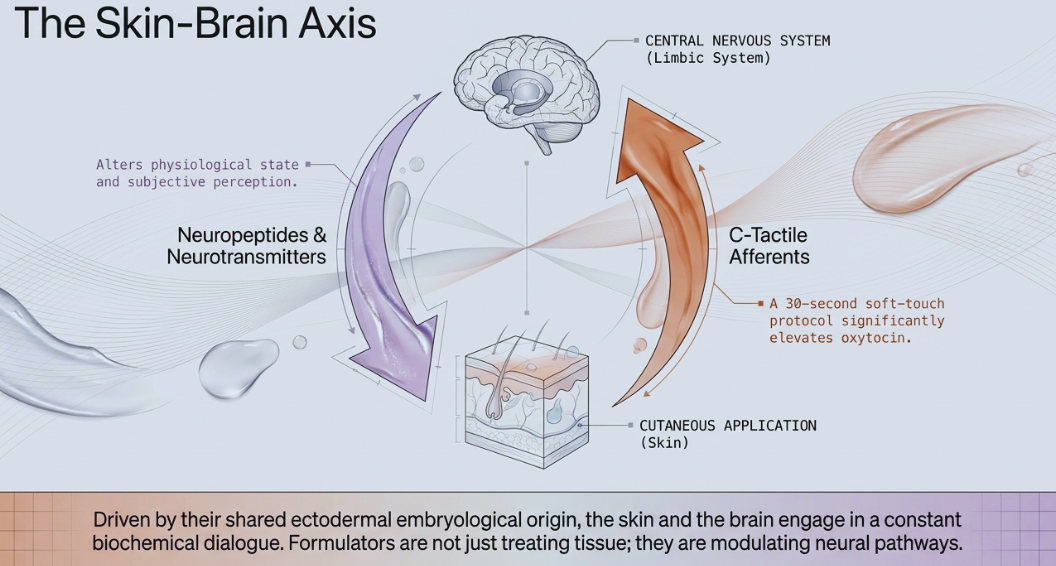
Rheological behaviour influences tactile perception, which is further modified by fragrance. Olfactory signals reach the brain within milliseconds and shape emotional response before tactile evaluation is complete.
For example:
- Light gel textures combined with fresh citrus profiles are perceived as hydrating and refreshing
- Rich cream systems paired with warm or woody notes communicate nourishment and repair
- Mismatched combinations create perceptual conflict, even when the formulation is technically robust
From a processing standpoint, this also means that viscosity targets, shear profiles and emulsion structure must be defined alongside sensorial intent, not after.
Rheology, Tribology and the Reality of Touch
Tactile perception remains one of the most critical drivers of product acceptance.
There is a direct relationship between rheological parameters and how a product is experienced. Viscosity at specific shear rates can predict perceived spreadability, stickiness and absorption behaviour.
However, the evaluation is not uniform across the skin.
The fingertip used during product pickup has higher sensitivity than facial skin. This creates a perceptual gap between initial impression and on skin performance.
From an engineering perspective, this means formulations must be optimised for:
- Pickup behaviour
- Rub out profile
- Transition under shear
- After feel
Each stage must be considered during formulation development, not evaluated in isolation.
Fragrance as a Functional Ingredient
Fragrance is often treated as a finishing element. In reality, it is a primary driver of perception and emotional response.
Olfactory signals are processed rapidly and influence how all subsequent sensory inputs are interpreted.
Fragrance also directly modifies tactile perception. Studies show that identical formulations are perceived differently depending on fragrance profile.
This creates a critical formulation requirement.
Fragrance selection must be aligned with:
- Texture
- Product positioning
- Target consumer expectations
- Duration of product use
From a processing perspective, fragrance must also be compatible with the formulation matrix to ensure stability and consistent release.
The Often Overlooked Role of Sound and Packaging
Auditory cues are rarely considered in formulation. However, they contribute to how a product is perceived in use.
Packaging sounds, closure mechanisms and application noises all signal quality and performance.
Even subtle acoustic differences can influence perception of hydration or dryness.
This means formulation design cannot be completely separated from packaging and delivery systems. The product must be engineered as a complete experience.
From Laboratory Parameters to Consumer Experience
Traditional development models often follow a linear structure:
Formulation → Testing → Sensory evaluation
Multisensory formulation requires a different approach.
Design must start from the intended experience and work backwards into formulation parameters.
This includes:
- Defining the emotional and functional positioning
- Mapping sensory cues across the product lifecycle
- Aligning ingredient selection with those cues
- Validating both instrumental and perceptual outcomes
Modern evaluation techniques such as temporal sensory analysis and biometric measurement are increasingly being used to capture how perception evolves during use.
This provides a more accurate representation of real consumer experience.
Why Multisensory Design Drives Commercial Success
Consumers do not separate performance from experience.
A product that performs well but feels inconsistent will struggle to build loyalty. A product that delivers coherent signals across all senses reinforces trust and repeat purchase.
This is particularly important in a market where claims, positioning and sensory expectations are becoming more closely linked.
Multisensory formulation is not about adding complexity. It is about improving alignment.
When formulation, processing and sensorial design are integrated, development becomes more efficient and outcomes become more predictable.
From Formulation to Experience Engineering
The evolution of cosmetic science is moving from single parameter optimisation toward integrated system design.
Five sense formulation engineering provides a structured way to translate this shift into practice. It connects ingredient selection, processing parameters and consumer perception into a unified framework.
For formulators and development teams, the key shift is clear.
Do not formulate products only to perform. Formulate them to be perceived as performing consistently across every interaction point.
If you are developing cosmetic products and want to integrate formulation, processing and sensorial design into a coherent and scalable framework, I can support you.
At Olalla Consulting, I work at the intersection of formulation science, sensory engineering and regulatory strategy to help create products that are technically robust and commercially successful.
👉 Visit https://www.olallaconsulting.com/the-green-chem-hive/ and explore how to design products that deliver both performance and perception in the real market.